Friday, June 10, 2011

CWEF Interns - Scholarship Students


As I stated in my last post, a few weeks ago, six high school students came to Kunming to intern for CWEF. They go to school at Concordia International School Shanghai (CISS) and are truly a fascinating bunch of kids. Last post I talked about the conclusions we came up with after interviewing several villages about drinking water projects. Here, I want to highlight the interviews we conducted with our scholarship students. Each year, CWEF gives out a handful of scholarships for middle and high school students. Without these scholarships, many students would be forced to stay at home and help with farm work.

Here are a few excerpts from the report written by Taylor Jurgens:
  • When parents or guardians were asked about personal education levels, the most common level of education was elementary school. 6 of the 18 female guardians went to elementary school but didn't necessarily graduate; 1 went to middle school and only 1 graduated high school. 6 had no education at all and were completely illiterate. Of the male guardians 7 went to elementary school, 2 went to middle school and 1 graduated high school. 4 had no formal schooling.
  • The average annual income for all families was roughly 4500 RMB which translates into about $680.
  • On average the families eat two meals a day consisting of corn, rice, potatoes and other vegetables. About once a week, they will eat meat such as pork or chicken. Students are given money to eat a meal at school, though many of the students skip their midday meal in order to make their allowance last as long as possible.
  • All of the scholarship students interviewed spent the school days living in the on-campus dormitories and went back to their village only on weekends and holidays.
  • All of the families said that had they not received the scholarship they would have paid or tried to pay for their child to go to school anyways. Some parents went as far as to say that they would sell the house and all they have because they know the importance of their children's education.
  • Students were also asked what their goals were for the future as well as what they wanted to be when they grow up. Many students expressed an interest in being doctors. The overwhelming amount said it was because they had a family member that was sick or in pain. Many also said they wanted to be teachers because they were inspired by influential teachers or the scholarship they had received. Other popular responses were lawyer, manager, government official and police officer. All students expressed a desire to use their education to first help their families and then help others who were in similar conditions.
  • Many students were brutally aware of just how poor they really were. Throughout the interviews, most cried and had a hard time admitting their financial situation. Many family members were thankful for the scholarship because it gave their children an opportunity to go to school. Even though basically all the parents said they would pay for their children's education even without the scholarship, looking at their situation, this didn't seem likely. The scholarships have obviously had an enormous impact on their lives. They have given the students an opportunity to make the world a better place in the future. Many students looked up to the workers at CWEF and wanted to help others in dire situations like themselves. More importantly, the scholarships seem to have given many students the hope and self-confidence to reach for their dreams, no matter how mighty or seemingly impossible.

A few photos of our scholarship students:

Sunday, June 5, 2011

CWEF Interns-Water Projects


These past two weeks CWEF hosted six high school interns from Concordia International School Shanghai (CISS) to help with various projects. I accompanied these six interns to two villages in Yunnan, one village that does not currently have a water system in place and another village that had a water project installed last fall by CISS. We interviewed families from both villages accessing the needs of the village without a water system and accessing how the new water project has helped the other village. Thanks to the interns hard work, we were able to gather all the information into a concise report laying out the villages needs and how a water project can help.

Two CWEF interns with a village woman

A few facts about village life:
  • The majority of families work as farmers raising cows, pigs, sheep, chickens and horses.
  • Most families eat two meals a day, morning and evening, that consist of corn, potatoes, rice and vegetables. Meat is eaten on the rare occasion.
  • The average annual income per family is 1,300 RMB or 200 USD.
  • This particular village's closest water source is 3 km away. Depending on if the family owns a horse cart dictates how often they get water. If they have a horse cart they can retrieve water once every 3 days and bring back 400 kg. If they do not have a horse cart, they need to go 1-2 times a day bringing back 40 kg each trip in buckets. This water is used for cooking and giving to livestock, rarely is it used for bathing.
  • Each villager washes their hands twice a day, in the morning and at night. They give themselves a sponge bath every 10-15 days.
  • The highest education level paid for by the government is elementary school so most villagers only have an elementary education. On the rare occasion someone will have finished middle school.
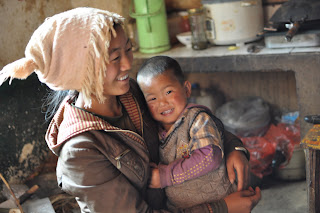
A village woman and her son during an interview

A few facts about a village with a completed water project:
  • Before the water project:
-There was one water source in the village but it would often run dry and was not clean.
-Families bathed every 10-15 days to once a month.
-Villagers wash their hands only twice a day, morning and night.
-Less crops were grown and less water was given to livestock.
  • After the water project:
-Families are able to raise more livestock and grow more crops increasing their annual income.
-Villagers bathe every 2-3 days washing their hands 3-4 times a day or if dirty.
  • The annual income for a family ranges from 0 RMB (villagers survive off of their crops but make no extra money) to 5,000-6,000 RMB (750-800 USD) all the way up to 20,000 RMB (3,300 USD)
Water from the new water system installed by CWEF and CISS

"Generally, the villagers recognize that a simple necessity like water is a gateway to a better life. With a new water system the villagers are able to find ways to provide for themselves rather than depend on donations. Water leads to more money, more money leads to more education, and more education leads to success."
-Written by Heather Taylor, CISS Intern


Thursday, May 26, 2011

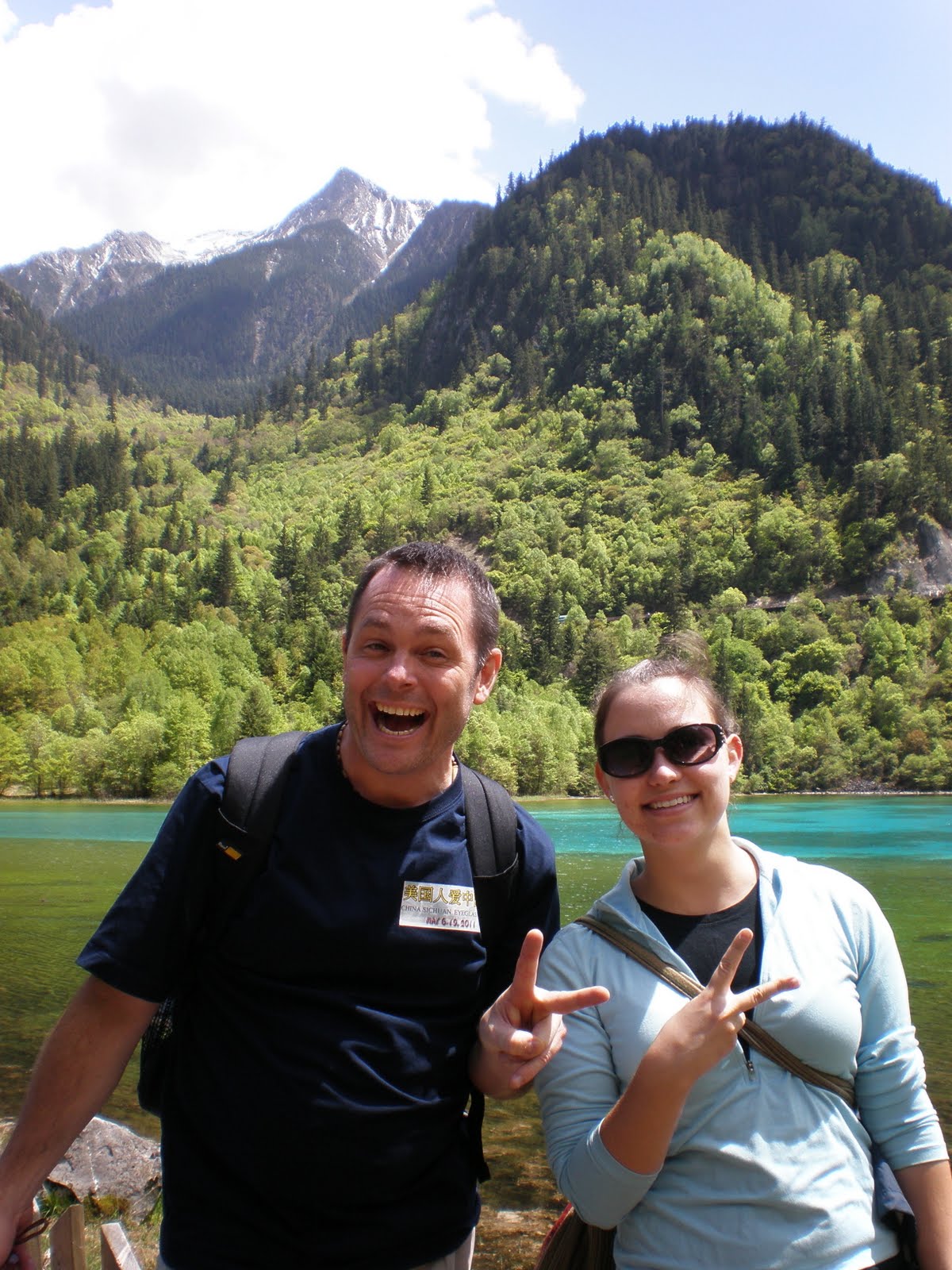
Jiu Zhai Gou..."The most beautiful place in China..."


During my recent eyeglass trip to Sichuan, the group stopped at a famous tourist stop, Jiu Zhai Gou (pronounced Geo J-eye Go). It has been referred to as the most beautiful place in China. It is located in northern Sichuan province and its name is due to the existence of nine blockaded Tibetan villages. It is regarded as a holy mountain and watercourse by the Tibetan people. It was truly gorgeous and I could not help but think how great G-d is.


Tibetan flags


Co-worker, Sean and I

This lake was called "Lake with Many Colors" and it truly had quite the spectrum

Two of our team members who dressed up in traditional Tibetan dress for a photo-opp


A nice Chinese man let me use his sweet hat for a photo


This bride and groom were taking their wedding photos with this gorgeous scenery

Saturday, May 21, 2011

Receive Your Sight

This past month I had the pleasure of accompanying a team from MOST M-nistries to Sichuan Province for an eyeglass service trip. Sichuan Province is north of Yunnan and its capital, Chengdu, holds the United States Consulate.

The team arrived and we headed straight out to Nanba, a town that was devastated in 2008 by an earthquake. The entire town needed to be rebuilt and when we arrived, three years later, we could tell they were finally getting back on their feet. During our seven days of service, we visited 8 schools, saw 1,725 patients and gave out 1,650 glasses. This team was so bl-ssed to have such experienced members who had been on several eyeglass teams before, our clinic days went as smoothly as could be. Many of the students who couldn’t communicate with us verbally just gave us hugs instead.

Students filed into the registration area, talked to the nurse and headed to the testing station. Here our volunteers would test their near and far-sidedness just like at the eye doctor. They would prescribe them an accurate prescription and send them to the dispensing station. Here we would test several pairs of eyeglasses on them and ask which was the clearest. I was located at this station to help with translation and and do my best to give them the best pair of glasses. Next, we sent them to the fitting station where our volunteers would try their best to adjust the size and nose pieces of the glasses to fit the students face. This was at times hard, as most of our glasses fit an average American’s face and nose, but with a smaller Chinese face and flatter nose, our technicians had their hands full. Finally the students proudly took their new glasses to the cleaning station and picked out a case.

Overall, the trip was a great success. Many students who could not see the blackboard can now do so without squinting. Many hugs were given and small relationships were built. With the language barrier, sometimes it can be hard to build relationships in such a short amount of time, but these volunteers showed their love in a big way. They showed their love in simple actions just as He did. We don’t know who was reached or whose lives were changed, it is in His hands now, and that we can put our faith in!

• • •

Next week, six interns from Concordia International School Shanghai come to Kunming to help CWEF with a few projects. We will head out to a project site where CWEF completed a water project and evaluate how the project has affected the village. Then we will go to a new village and evaluate if it is a place where we can do a water project in the future. Please send us your pr-yers for safety and good health.

• • •

CWEF is still looking for a new Service Coordinator to fill my role this fall. If you are interested or know someone who might be, email me at edurfey@gmail.com

• • •

Thank you to all my supporters from around the globe. I wouldn’t be able to be here without your gifts and I truly appreciate the generosity. I am truly bl-ssed.


Thursday, April 28, 2011

"They are not good drivers"

In a recent article in the Los Angeles Times, China's hazardous driving is spotlighted and I couldn't agree more with what the author had to say. China is a booming country and along with the new high rise apartment buildings and new fashion malls popping up everywhere, so are new drivers. China recently passed the United States to become the world's top buyer of new vehicles, nearly 50,000 a day. And although China currently has 40% fewer cars on the road than the United States, it doubles the number of people that die in road accidents each year. Driving in China certainly is not the same thing as driving in America. There are so many more things to watch out for here, the same rules simply don't apply. Many pedestrians act as if the auto revolution never happened and many motorists don't obey common traffic rules. I like to think of the roads in China as "survival of the fittest". Usually the biggest vehicle wins. Then theres the difference between cars, electric-scooters and bicycles. While few cars obey traffic rules, scooters and bicycles definitely do not.

Because of the sheer number of people living in China, if a car stopped at a pedestrian crossing, they might be there for hours waiting for the crowds of people to part. Cars that miss an exit on the highway will often slam on their brakes, throw the car in reverse and stop traffic to get back to their exit. When making a right or left turn, cars do not yield to oncoming traffic but force other cars out of their way. Lane markers are a suggested rule to follow but don't mean much. I often see cars attempting a 3 point turn in the middle of road, blocking all lanes of traffic. I regularly take public buses and we are often stopped in traffic with a car directly facing us, almost as if its a duel. I chuckle to myself because the bus will always win, its the biggest. When crossing the road, it doesn't matter if I am in a cross walk or not, I have to look in all directions and for all types of vehicles. Usually if a motorist sees you, they will avoid you, but I never depend on them.

I often see accidents on the road that easily could have been avoided. People just don't obey simple rules like yielding when making a turn, using turn signals, stopping at red lights and staying in your lane. China is far from becoming a country that obeys traffic laws. If the rules are not enforced (which they aren't), people will continue to drive recklessly. I have no desire to become a driver here and even riding my bike on the streets is stressful!

Read the full article at: http://articles.latimes.com/2011/apr/20/business/la-fi-china-crash-20110421

Thursday, April 21, 2011

A Day in the Life of a Chinese Student...


On our recent trip to Deze Middle School to teach English, I got a copy of a students schedule. I was shocked to see how busy these middle school students are. The students live at the school Mon-Fri and go home on the weekend. They live in small dormitories of 12 people to a room. So the next time your son or daughter complains about having too much homework or too many classes, inform them of the life of a Chinese student in the countryside.

Day to Day Schedule:

6:30 - Wake Up
6:40-6:50 - Exercise
6:50-7:15 - Breakfast
7:15 - 7:45 - Reading
7:50 - 8:35 - Class
8:45 - 9:30 - Class
9:30 - 9:50 - Exercise
9:50 - 10:35 - Class
10:45 - 11:30 - Class
11:30 - 12:00 - Lunch
12:00-1:10 - Rest
2:00-2:45 - Class
2:55-3:40 - Class
3:50-4:35 - Class
4:35-5:05 - Homework
5:05-5:35 - Dinner
6:00-7:00 - Study time
7:30-8:10 - Class
8:20-9:00 - Class
9:10-9:50 - Class
10:10 - Bedtime

A student dormitory

Wednesday, April 13, 2011

English Teaching - Creativity

Last week I traveled outside of Kunming to the countryside of Deze to teach English at a middle school for two days. I was accompanied by three women from Hong Kong and Alma, CWEF’s Education Director. We were welcomed by a large group of teachers from the Education Bureau who were very eager to have us teach at their school. As we prepared for the following days activities, I soon realized that teachers were coming in from around the county to observe our foreign teaching techniques and were taking our lessons very seriously.

Each class consisted of 60-70 students and each period lasted 45 minutes. Such large class sizes initially posed as a problem, but since 4 of us were teaching each class we were able to get around to each student and help them. We emphasized creativity in the classroom: drawing, singing, dancing, games, etc. Chinese classrooms can be a bit boring, with emphasis on memorization and repetition so we really wanted to show the teachers there are more fun ways to learn English.

We brought the students outside and gave them chalk to draw activities they like to do. We were teaching Who, What, When and Where, so students made sentences such as: “On Monday, I like to play ping pong with my sister on the playground.” Leaving the classroom to have class was such a foreign concept to these students they were very reluctant to even start drawing on the playground with the chalk. We also had to encourage them to get out of their seats to move around the classroom when doing other fun activities and games. We tried to be as silly as possible to get the kids laughing and enjoying themselves and at the end of the day, one of the English teachers in the back of the room commented that we seemed very professional.

Overall, it was a great trip. At the end of each day I certainly was exhausted. I have to give credit to all teachers out there, getting in front of a classroom full of students and keeping them engaged is an exhausting activity. I only did it for two days, I can’t imagine doing it year after year!

I hope the English teachers that observed us can utilize the teaching techniques we used and engage their students more. In countryside schools, much like the one we were at, it is common for students to drop out after middle school to go work in the city or help their parents on the farm. Many of them don’t see a use for learning English and their classes are so boring they don’t care to try. It can be hard to find ways for students to practice their English, but we encouraged them to speak as much as they can to their teachers and peers.

Hopefully, CWEF can continue to work with this school and provide English lessons and teaching excursions to encourage these students to study and work hard so they can get into college.


Deze countryside

A student showing her paper in the front of the class

Working my way around the classroom which is hard to do with 70 students

Students drawing their own pictures

Megan, from Hong Kong, teaching "happy" to the class

A view of the entire middle school, 800 students

Student dormitories

Ping pong table on the playground

So cute

Students eating their lunch outside